Bespoke menswear: from Savile Row to the sherwani
What "bespoke" really means, how it differs from made-to-measure, and how the same principles shape Indian menswear couture.
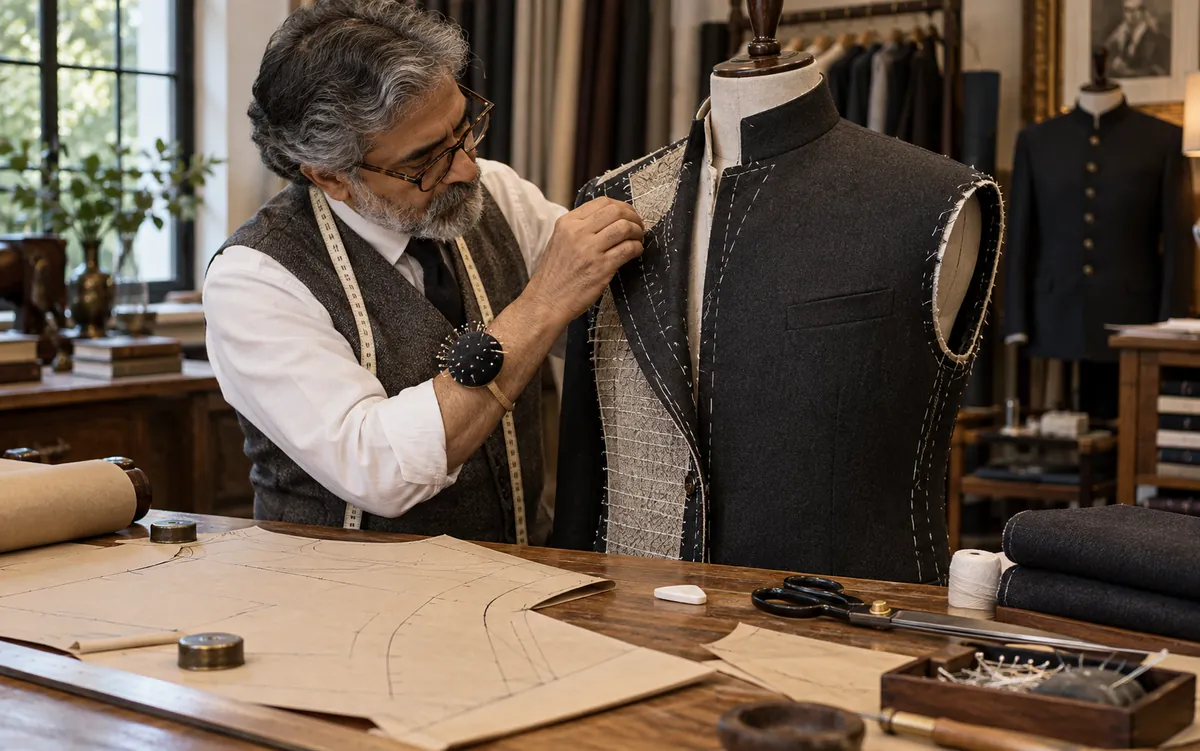
Menswear couture is called bespoke. The word comes from the cloth being "spoken for" by a particular customer.
Bespoke vs made-to-measure
- Bespoke: a new pattern drafted for one client, cut and sewn largely by hand, with several fittings.
- Made-to-measure: an existing pattern adjusted to the client's measurements, mostly machine-made.
What you pay for
A floating canvas that shapes the chest, hand-padded lapels and collars, and a fit built around posture and movement.
The Indian connection
Sherwanis, achkans and bandhgalas follow the same logic: the cut, shoulder and collar matter more than the ornament. Bespoke Indian menswear combines tailoring with embroidery placed to follow the line of the garment.
The bespoke process
- Consultation: choosing cloth, style and purpose.
- Measuring: often more than 20 measurements, plus notes on posture and shoulder slope.
- Pattern: a unique paper pattern drafted for the client.
- Baste fitting: the garment is loosely tacked together and fitted.
- Forward fitting: closer to finished, with sleeves and collar set.
- Finishing: hand-sewn buttonholes, pressing and final checks.
Canvas construction
A fully canvassed jacket has a layer of wool or horsehair canvas between the outer cloth and the lining, shaped and hand-stitched so the chest has natural curve and the lapel rolls softly. Half-canvas jackets use canvas only in the upper chest and lapel. Fused jackets glue an interlining in place; they are cheaper and quicker but less shapely and can bubble over time.
Cloth choices by climate
- Hot and humid climates (South and Southeast Asia, Gulf, West Africa): open-weave wool, wool-linen, cotton and silk blends; half lining or unlined.
- Temperate climates (Europe, North America): worsted wool in mid weights year-round, flannel and tweed for winter.
- Cold climates: heavier flannels, cashmere blends and full canvas for warmth and shape.
Bespoke in Indian occasion wear
The bandhgala and sherwani benefit most from bespoke methods: a canvassed front keeps the long line smooth, and the stand collar must sit precisely on the neck. Embroidery is planned after the pattern is final, so motifs sit on the collar, placket and cuffs in proportion to the client.
Offering made-to-measure well
For brands that cannot offer full bespoke, a well-run made-to-measure service with clear measurement guidance, a fitting garment and one alteration covers most customers. It is also a strong way to sell occasion wear online to clients in other countries.
Common questions
Is bespoke worth the price? For clients who need a precise fit or want a garment for many years, yes: a canvassed bespoke jacket shapes better and can be altered more easily.
How long does a bespoke suit take? Typically several weeks to a few months, with two or three fittings.
Can a sherwani be bespoke? Yes. The same methods, a unique pattern, canvassing and several fittings, apply to sherwanis and bandhgalas.