The menswear couture guide: sherwani, bandhgala, achkan
The key silhouettes of Indian menswear couture, how they differ and what to get right in fit and finishing.
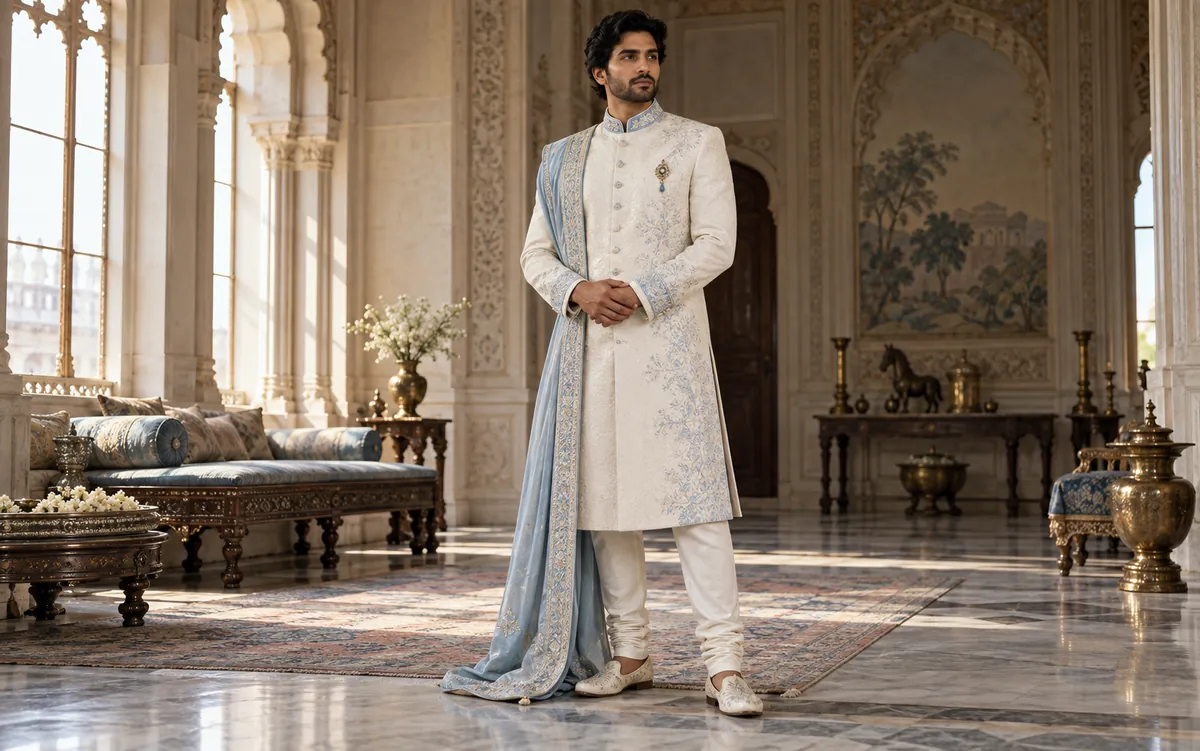
Indian menswear couture is tailoring first. The silhouettes are simple; luxury comes from cut, fabric and finishing.
Sherwani
A long coat, usually knee length or longer, with a stand collar and front opening. Worn for weddings, often in brocade, raw silk or velvet, and paired with churidar, dhoti or straight trousers.
Achkan
Close to the sherwani but typically more fitted through the body, with a cleaner line. Often lighter in ornament.
Bandhgala
A hip-length jacket with a closed band collar, the most versatile piece in Indian formalwear. It works from receptions to formal dinners.
What to get right
- Shoulder and chest fit: these cannot be easily altered later.
- Collar height and stand: comfortable but crisp.
- Canvas and interlining so the front stays smooth.
- Embroidery placement that follows the cut: collar, placket, cuffs and hem.
Trend direction
Forecut sees ivory and pastel sherwanis with tone-on-tone thread work and velvet bandhgalas for winter as strong directions, with jewellery-like details such as collar brooches.
Other pieces in the wardrobe
- Jodhpuri suit: a bandhgala jacket with matching trousers, formal and close to Western suiting.
- Indo-western jacket: shorter or asymmetric jackets worn over kurtas for sangeet and receptions.
- Kurta and waistcoat (Nehru jacket): the most worn occasion look, from mehendi to festivals.
- Shawl and stole: pashmina, jamawar or embroidered stoles add warmth and ceremony in winter weddings.
Fabrics and their uses
- Raw silk and dupion: crisp, holds the sherwani line, takes embroidery well.
- Brocade and jamawar: woven pattern for the groom or close family; minimal embroidery needed.
- Velvet: rich and warm for winter receptions; best in deep colours.
- Linen-silk and cotton-silk: lighter options for day functions and warm climates.
- Suiting wool: for Jodhpuri suits and bandhgalas worn at formal dinners.
Fit points to check at each fitting
At the first fitting, check the shoulder line, chest ease and sleeve pitch. At the second, check the collar stand, front edge and length, and the drape of the hem when the client sits. At the final fitting, check buttons and loops, embroidery alignment across seams and how the garment moves with a stole or safa.
Menswear occasion wear around the world
Indian occasion menswear is worn far beyond India: at South Asian weddings in the UK, Canada, the US, the Gulf and Australia, and increasingly as eveningwear by non-South Asian clients. For these markets, lighter constructions, versatile colours such as ivory, navy and bottle green, and pieces that can be re-worn (a bandhgala with trousers, a kurta with a waistcoat) sell better than single-use outfits.
Pricing and lead time
A bespoke sherwani with hand embroidery typically needs several weeks to a few months, depending on embroidery area and fittings. Communicate lead times early in the wedding season, and offer made-to-measure options with machine embroidery for shorter deadlines.
Common questions
What is the difference between a sherwani and a bandhgala? Length and formality: a sherwani is a long coat, usually knee length or longer, worn for weddings; a bandhgala is hip length and more versatile.
Which colours sell best in groom wear? Ivory, beige and pastels for day events, and deeper colours such as maroon, bottle green and navy for evening and winter functions.
How far ahead should a groom order? For bespoke with hand embroidery, ideally three to four months; made-to-measure options can be faster.