A designer's guide to Indian handlooms
Khadi, Chanderi, Maheshwari, Banarasi, ikat and more: what makes each one special and how to design with it.
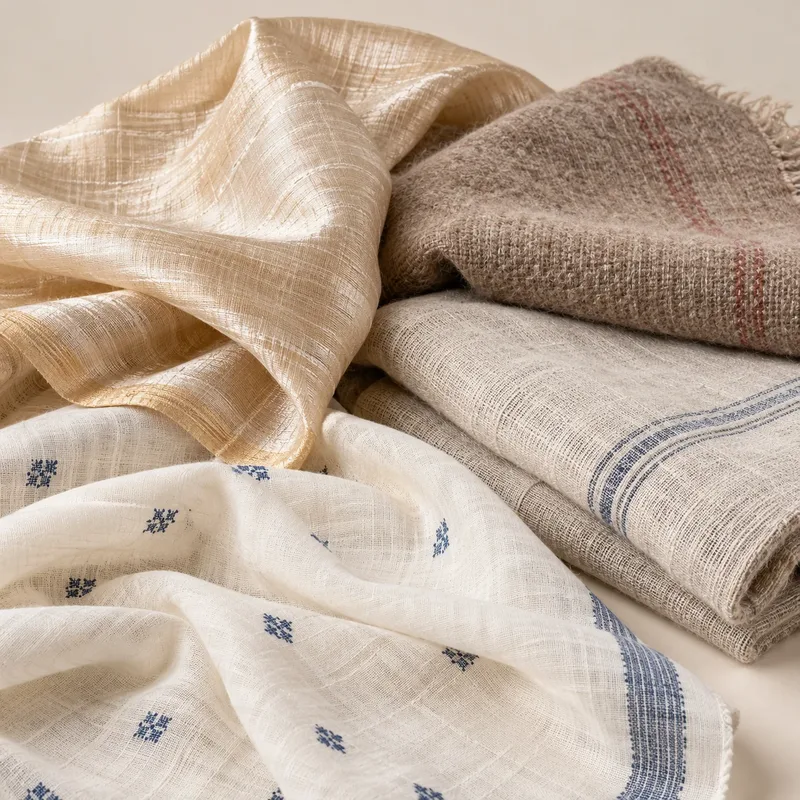
India has one of the richest handloom traditions in the world. Each region's weave has its own fibre, structure and motifs, and knowing them helps designers use them with respect and confidence.
Light and breathable
Khadi is hand-spun and hand-woven, with a gentle irregular texture. Chanderi and Kota doria are fine and airy, ideal for summer kurtas and dupattas. Jamdani adds motifs inlaid by hand into fine muslin.
Festive silks
Banarasi brocades carry rich zari jacquard motifs; Kanjeevaram is heavy silk with contrast borders; Paithani is famous for its peacock and lotus borders; Maheshwari offers lighter silk-cotton with reversible borders.
Resist-dyed
Ikat (Pochampally, and the double ikat Patola) is dyed before weaving, so the pattern appears as the yarns meet. Bandhani and Ajrakh are resist-dyed after weaving.
Designing with handloom
- Ask about provenance: where and by whom the cloth was woven.
- Expect small irregularities: they are part of the value.
- Test shrinkage and colour fastness before cutting.
- Let the cloth lead: simple cuts often show handloom best.
- Credit the craft in product descriptions.
Regional map
- Uttar Pradesh: Banarasi silk and brocade from Varanasi.
- Madhya Pradesh: Chanderi and Maheshwari.
- Rajasthan: Kota doria.
- West Bengal and Bangladesh: Jamdani muslin.
- Tamil Nadu: Kanjeevaram silk.
- Maharashtra: Paithani.
- Telangana: Pochampally ikat.
- Gujarat: Patola double ikat; Kutch weaves.
- Assam: Muga and eri silks.
Geographical Indications
Many Indian handloom textiles are registered as Geographical Indications (GI), which protects the name for products made in the region by traditional methods. Using a GI name for an imitation can mislead customers. When buying, ask for proof of origin, and use the protected name only for genuine products.
Handloom vs powerloom
Handloom fabric is woven on a hand-operated loom, which gives small variations in tension and texture. Powerloom versions of the same designs are cheaper and more uniform. Both have a place, but they should be described honestly. India's Handloom Mark scheme helps identify genuine handloom products.
Selling handloom internationally
- Lead with the story of place and maker, supported by documentation.
- Offer simple silhouettes that let the weave lead.
- Provide clear care guidance; many handlooms need gentle washing.
- Show close-up texture images; customers abroad may not know the weave.
Handloom and climate
Light cotton handlooms such as khadi, chanderi and jamdani are naturally suited to hot climates and are increasingly sought after in summer collections worldwide, from the Mediterranean to Australia.
Common questions
What is the Handloom Mark? An Indian government scheme that labels genuine handloom products to distinguish them from powerloom versions.
Which handlooms suit summer? Khadi, chanderi, kota doria and jamdani are light and breathable.
Is handloom more expensive? Usually yes, because weaving is slower. The value lies in texture, craft and provenance.