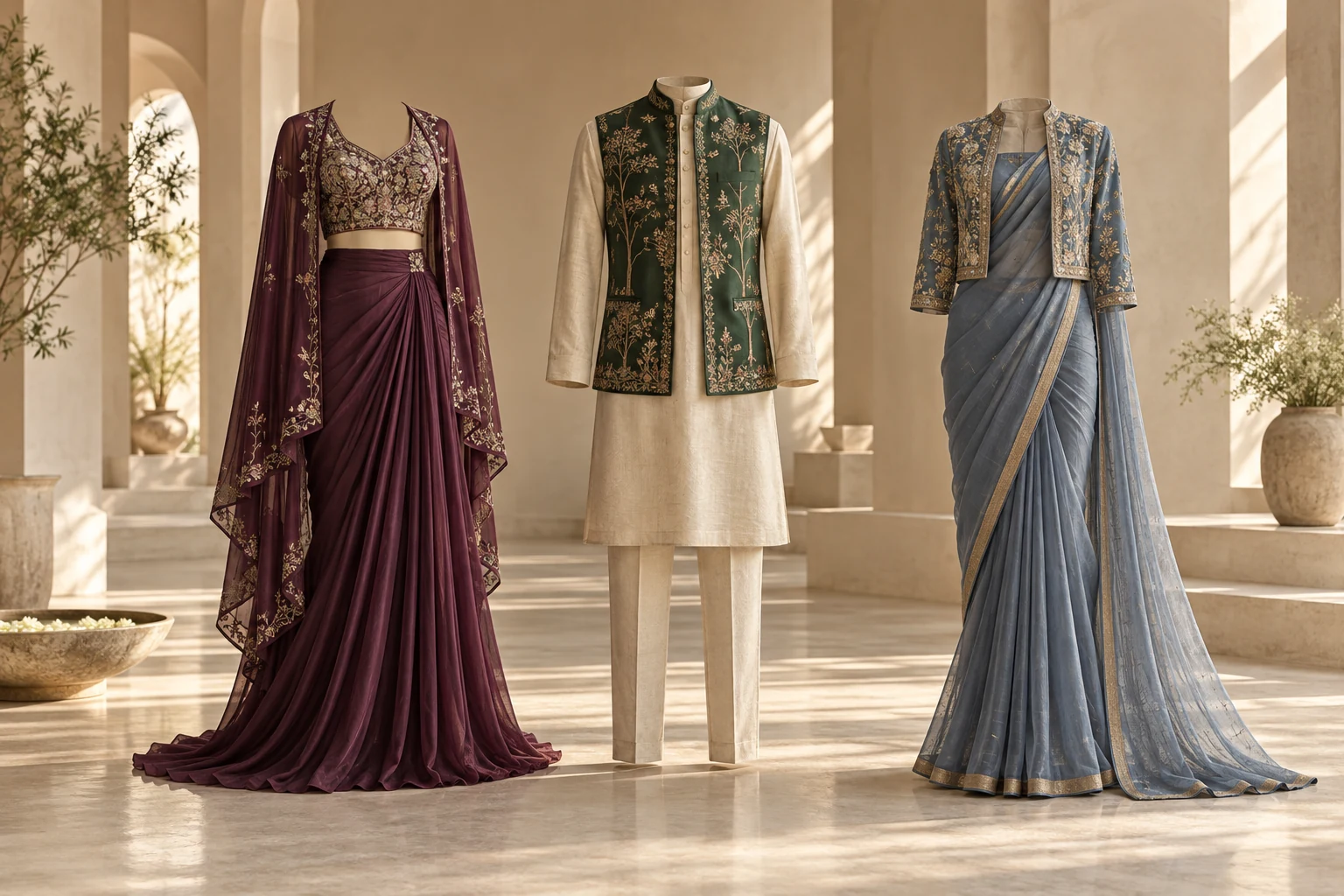
Festive & wedding season now · Oct 2026 – Dec 2028
India Forecast 2026–28
What India will wear next: handloom with quiet luxury, indigo and blue-white, festive pieces that are easy to wear, crafts going global, and Gen Z fusion. Covers ethnic and western wear, footwear, fabrics, embroidery and trims, with prices in rupees.
Handloom quiet luxuryIndigo, blue and whiteFestive made easyIndian craft goes globalGen Z fusion
Festive & wedding season now · Oct 2026 – Dec 2028
India Forecast 2026–28
What India will wear next: handloom with quiet luxury, indigo and blue-white, festive pieces that are easy to wear, crafts going global, and Gen Z fusion. Covers ethnic and western wear, footwear, fabrics, embroidery and trims, with prices in rupees.
Based on Indian runway, retail and trade coverage
8Categories
31%Emerging
46%Rising
23%Peaking
1%Fading
Status mix · Festive 26
Emerging 31%Rising 46%Peaking 23%Fading 1%
Top movers to act on now
Key colour · Lakmé Fashion Week 2026
Indigo
Pantone 19-3864 TCX · #2f3f7a
Blue, from deep indigo to blue-and-white, was the most-seen colour story at Lakmé Fashion Week 2026. Use it on denim, handloom kurtas and printed co-ords.
Pairs withIvoryChampagne goldRust
Key colour · Festive & wedding 2026
Emerald
Pantone 18-5845 TCX · #0f6b4f
Jewel tones still lead festive wear, but in richer, more refined shades: emerald, sapphire and deep wine, often with champagne or antique gold.
Pairs withChampagne goldDeep wineIvory
India fashion calendar
Five seasons, one plan.
Festive 26 is open to everyone. Later seasons are open to signed-in members now, and to everyone at launch.
AI-generated forecast concept
Now · openFestive 26Oct 2026 – Feb 2027
Dussehra, Diwali, Bhai Dooj and the winter wedding season
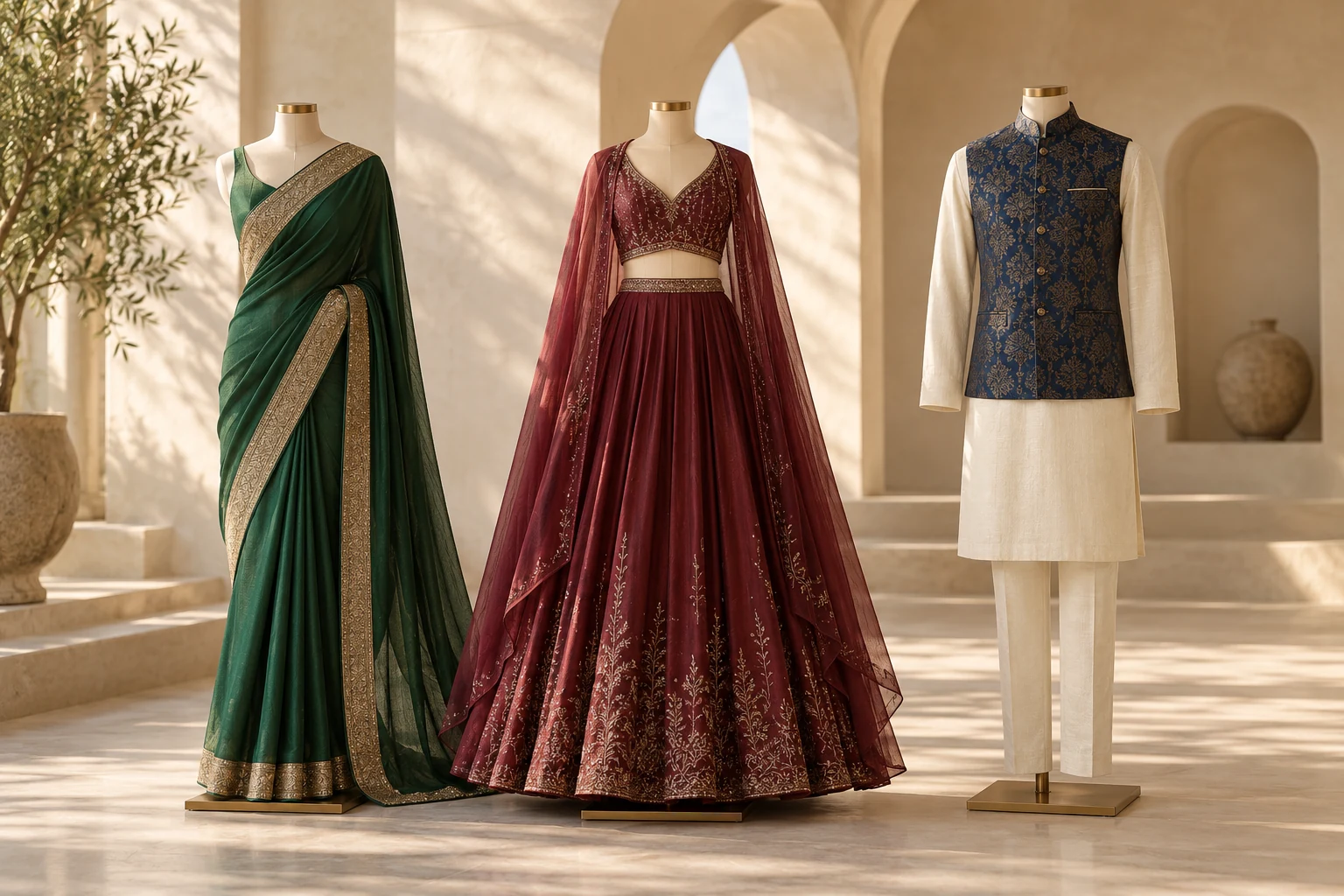
Festive made easy: pre-draped sarees, kurta co-ords, cape and light organza lehengas, velvet and brocade menswear, Kolhapuris.
Plan: In stores now. Reorder winners for December–February weddings.
AI-generated forecast concept
Opens at launchSummer 27Mar – Jul 2027
Holi, summer weddings and resort travel; validate Eid timing separately
Build around breathable separates, fluid drapes and light craft. Reserve sheer, playful and experimental surfaces for small capsules rather than making them the whole range.
Plan: October–November 2026: Set customer, occasion and price architecture; source fabric and make first silhouettes.
AI-generated forecast concept
Opens at launchFestive 27Aug – Dec 2027
Rakhi, Onam, Ganesh Chaturthi, Navratri, Durga Puja, Diwali and weddings
Plan festive capsules around lighter embellishment, adaptable separates and rich textile character. Treat sculptural metallic work as an experimental premium edge rather than a volume assumption.
Plan: January–March 2027: Revalidate against Indian runway and brand launches; approve regional assortment and supplier capacity.
AI-generated forecast concept
Opens at launchSummer 28Mar – Jul 2028
Holi, summer weddings and resort travel; validate Eid timing separately
Explore fewer, more useful pieces: breathable modular sets, repair-friendly construction and identifiable local craft. These are conditional development scenarios to revisit when 2027–28 signals arrive.
Plan: April–September 2027: Recheck SS28 trade and runway inputs as they become available; revise or reject these scenarios.
AI-generated forecast concept
Opens at launchFestive 28Aug – Dec 2028
Navratri, Durga Puja, Diwali and the wedding season
Explore occasionwear whose value comes from reconfiguration, provenance and aftercare. This is an original Forecut planning scenario, not a claim about confirmed 2028 consumer preferences or designer collections.
Chanderi, Maheshwari, khadi and tussar in calm colours, with little embellishment and beautiful cloth.
Handloom
Chanderi
Tone-on-tone
Explore theme →
Indigo, blue and white
Indigo denim, blue-and-white prints and tailoring were the most-seen colour story on the Indian runway.
Indigo
Denim
Blue-white
Explore theme →
Festive made easy
Pre-draped sarees, embroidered co-ords, kaftans and light lehengas that look festive without the effort.
Pre-draped
Co-ords
Cape lehenga
Explore theme →
Indian craft goes global
Kolhapuris on the Prada runway, mirror work, Rabari and kantha embroidery, block prints and bandhani.
Kolhapuri
Mirror work
Kantha
Explore theme →
Gen Z fusion
Kurtas with jeans and sneakers, sarees with trainers, oversized fits and co-ords: India's young shoppers mix it all.
Fusion
Oversized
Co-ords
Explore theme →
Key colours
India colour palette
EmeraldPantone 18-5845 TCX #0F6B4F
SapphirePantone 19-4050 TCX #1F4E9C
Deep winePantone 19-1940 TCX #6E1F33
Champagne goldPantone 14-0935 TCX #D8C08A
SagePantone 15-6414 TCX #9FAE8F
RustPantone 18-1248 TCX #B5522B
Dusty rosePantone 15-1611 TCX #D9A3A6
IndigoPantone 19-3864 TCX #2F3F7A
IvoryPantone 11-0104 TCX #F3ECDC
Forecut India · Summer 27
Air, craft and ease
Near-term forecast · medium directional confidence; product demand unmeasured
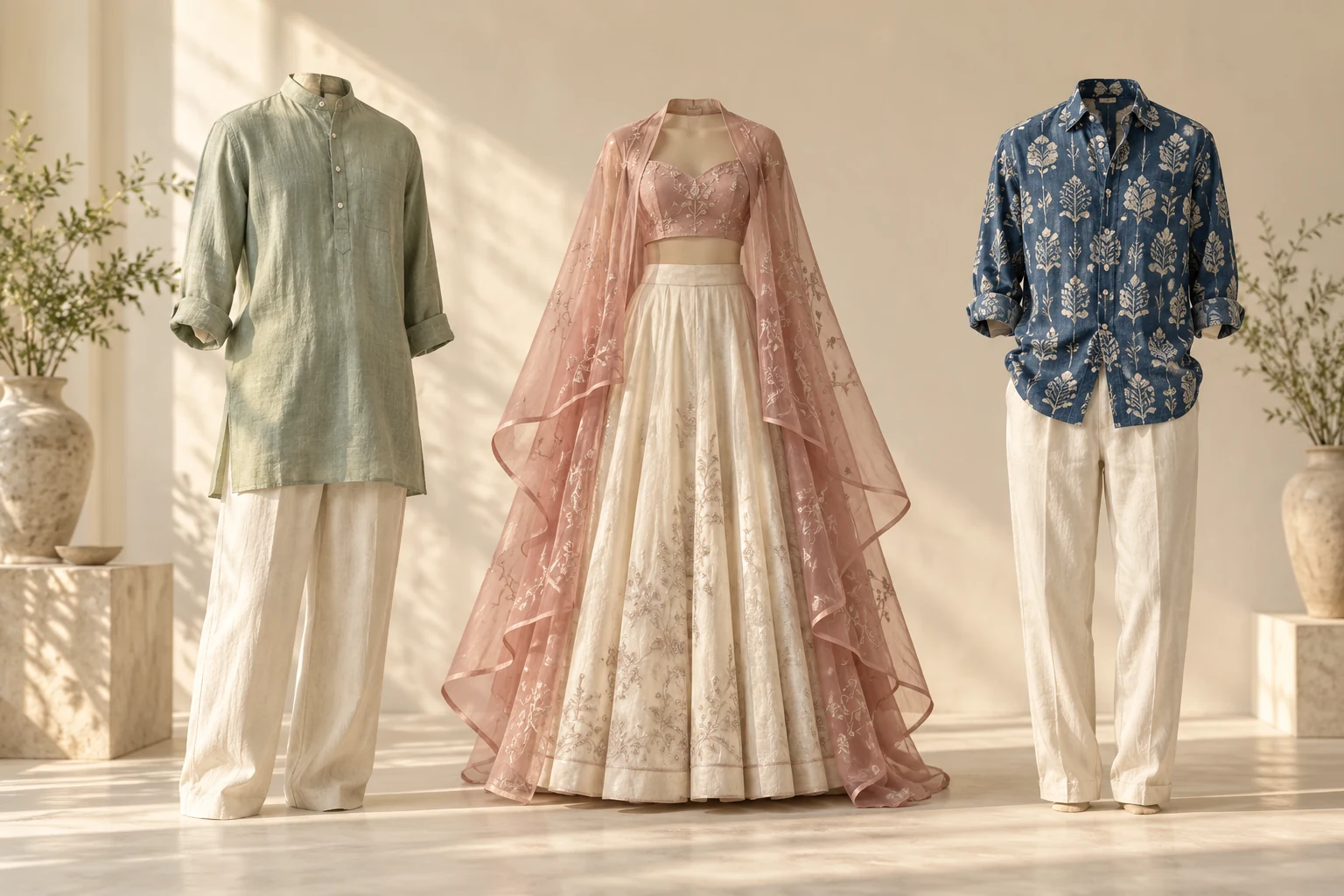
Build around breathable separates, fluid drapes and light craft. Reserve sheer, playful and experimental surfaces for small capsules rather than making them the whole range.
Research reviewed 15 October 2026 · Original Forecut analysis
Complete season report with images, all active details, palette, design guidance, calendar and sources.
Original AI-generated Forecut concept art. Not a documented runway image.
Direction 01
Cloth before decoration
Summer comfort is the starting point. Develop tactile cotton, linen and fine woven sets whose value comes from handle, proportion and finish.
Compare unlined and half-lined samples. Test shrinkage, opacity, seam slippage and hand feel after laundering. Avoid heavy fusible panels that defeat airflow.
Commercial action
Protect easy-care core styles; introduce higher-cost handloom in a tightly edited premium capsule. Validate supplier lead times before range sign-off.
Indian brand reference for mud-resist, indigo and restrained handmade detailing. A prior-season retail offer, not a 2027 collection.
Direction 02
Light, with coverage
Sheer runway layers become wearable when opacity is designed into the garment. The Indian opportunity is a light overlay with an intentional inner, not an exposed look copied from a show.
Build the range
Organza over cotton-silk; airy cape over a day lehenga; fluid dupatta; sleeveless inner with a loose shirt.
Development notes
Specify inner length, armhole coverage and attachment points. Check snagging, perspiration marks and movement in daylight.
Commercial action
Offer the inner as part of the product; keep the outer usable with existing wardrobe pieces. Test colour and size demand before widening.
Airy layering and adjustable silk drapes suggest movement-led summer construction; luxury runway evidence does not establish Indian demand.
Direction 03
Playful craft, controlled scale
Use handwork as a recognisable small detail, with clear maker attribution. Current designer and brand references support experimentation without establishing a universal trend.
Textile appliqué, lighter occasion silhouettes and practical pockets provide a useful wedding-guest development reference.
Original working palette
Summer 27 colour direction
Use for sampling and range coordination. Validate physical lab dips under your selling light; these digital colours are not textile standards.
Unbleached chalk#F1E9D8
Leaf mist#A9B89C
Rose clay#D6A2A7
Inky blue#314779
Warm terracotta#B75C42
Category opportunities
Womenswear
Prioritise light kurta separates, easy sarees and day-function layers. Test a covered sheer capsule; keep fitted statement bodices selective.
Menswear
Develop linen and cotton-silk kurtas, soft jackets and straight trousers. Comfort construction should be visible in the product explanation.
Fusion & western
Use fluid shirts, relaxed sets and craft accents. Build travel versatility through pockets and adjustable styling rather than excess utility trims.
Footwear
Develop padded flats and flexible occasion shoes. Wide-fit grading, rub testing and outsole grip are essential; no demand uplift is assumed.
Textiles & trims
Cotton, linen blends, light handloom and restrained embroidery lead development. Specify composition, weight and care; do not call a fabric sustainable without proof.
Development calendar
October–November 2026Set customer, occasion and price architecture; source fabric and make first silhouettes.
December 2026Approve washed fit samples, colour fastness, opacity and costing; book craft capacity.
January–February 2027Complete pilot production, product photography and size checks; phase deliveries by climate and occasion.
March–July 2027Review actual full-price sales, returns and replenishment weekly; do not confuse social engagement with purchase.
What would change this forecast?
Confirm Holi and Eid drop timing separately; lunar dates can shift.
Look for repeated lighter construction across Indian SS27 shows, not one standout look.
Stop a sheer or handwork option if opacity, care or quality complaints exceed your own benchmark.
Research sources & methodology · 8 sources
Forecut editorial forecasts synthesise public Indian designer interviews, international SS27 show notes, textile-trade coverage and brand collections. Runway presence is not sell-through. Lifecycle labels are qualitative development priorities, not measured market shares. 2028 entries are conditional scenarios; no 2028 runway or sales evidence is claimed. Palettes are original Forecut working colours, not an official colour authority forecast. Festival groupings are merchandising windows, not verified religious dates; Eid timing requires a separate calendar check.
Hand knitting and repurposed materials illustrate small-scale circular design. Commercial consistency and supply still need checking.
Forecut India · Festive 27
Craft with a second life
Forward forecast · medium-low directional confidence; recheck against 2027 Indian shows
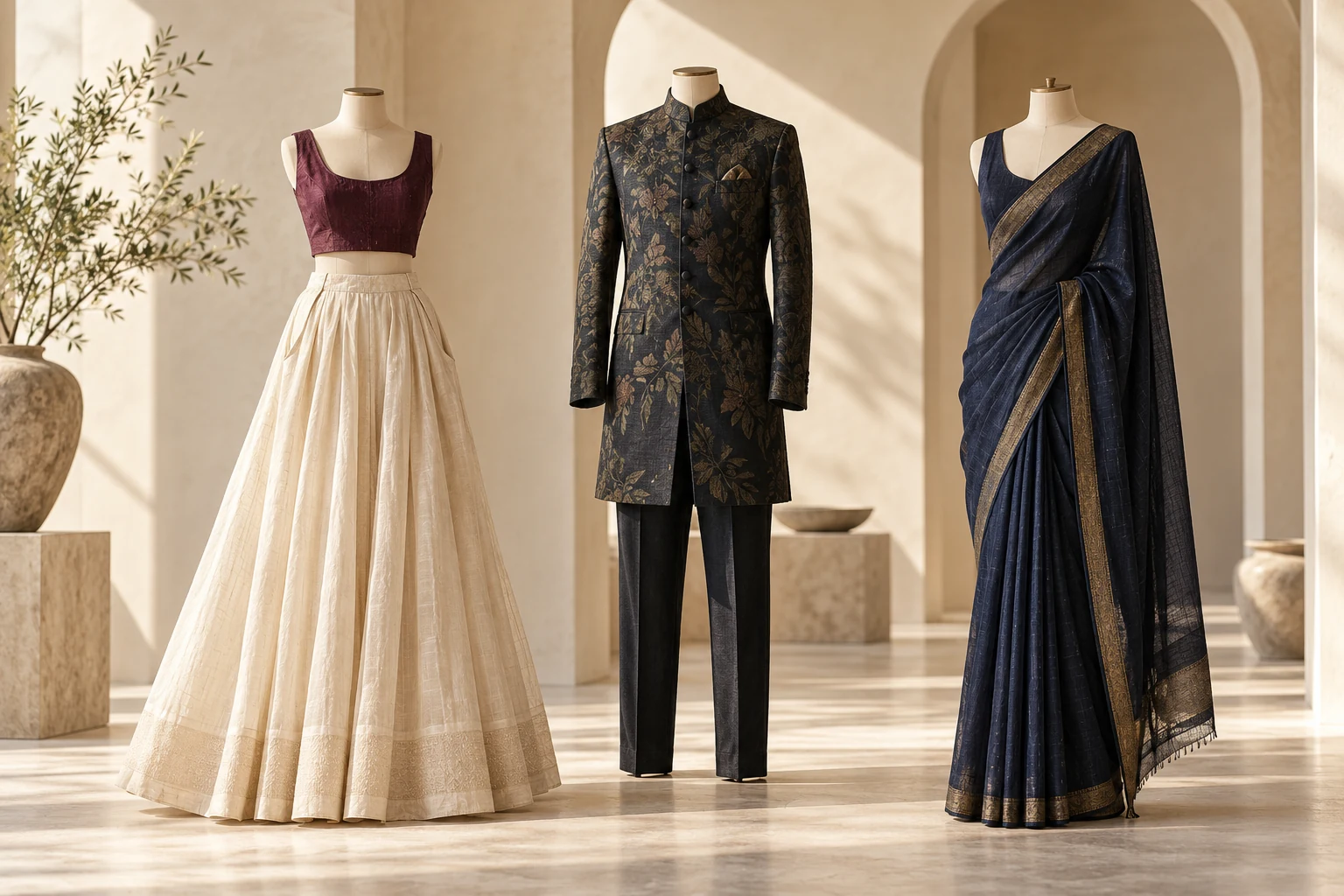
Plan festive capsules around lighter embellishment, adaptable separates and rich textile character. Treat sculptural metallic work as an experimental premium edge rather than a volume assumption.
Research reviewed 15 October 2026 · Original Forecut analysis
Complete season report with images, all active details, palette, design guidance, calendar and sources.
Original AI-generated Forecut concept art. Not a documented runway image.
Direction 01
Textile becomes the occasion
Use the weave and placement of craft to create festive identity. The 2026 couture inputs support fresh treatments of familiar techniques, not a claim that every heritage craft is accelerating.
Public textile-fair overview puts material development at the centre. Used as a long-lead input, not as a reproduced proprietary forecast.
Direction 02
Rewear the celebration
Design wedding-guest pieces to be useful after the event. Lighter construction and modular styling are Forecut development recommendations anchored in current Indian occasionwear practice.
Build the range
Lehenga with a wearable separate blouse; detachable cape; reversible waistcoat; light occasion skirt with pockets.
Development notes
Make fastenings accessible, include alteration allowance and test pocket distortion. Photograph both dressed-up and everyday combinations.
Commercial action
Use bundles and separate purchasing to improve outfit flexibility. Test attach rates before multiplying accessory SKUs.
Designer interview: functional linings, wearable drapes and tonal craft in menswear. An occasionwear input, not measured retail demand.
Direction 03
Light as ornament
Material reflection can deliver impact with fewer all-over trims. Reflective couture is a premium signal with substantial weight, repair and sourcing risks.
Build the range
Small pearl-effect borders; metallic-cord accents; controlled tissue panels; a statement brooch.
Development notes
Sample skin contact, sharp edges, tarnishing and storage. Offer repair guidance and keep non-washable components removable where possible.
Commercial action
Keep fragile or expensive surfaces made-to-order or in limited capsules. Never equate couture visibility with volume readiness.
Pastel Bandhani on fluid bases and reinterpretations of Patola and Kantha. Supports craft experimentation, not a mass-market adoption claim.
Direction 04
Menswear, engineered for the event
Combine Indian textile knowledge with movement and personal styling. Regional weather and event format matter more than a single national festive uniform.
Fit across body types and test long seated wear. Consider breathable linings and secure internal fasteners without replicating a designer’s proprietary mechanism.
Commercial action
Merchandise by event and climate. Offer lighter wedding-guest options beside more elaborate groom pieces.
Designer interview: functional linings, wearable drapes and tonal craft in menswear. An occasionwear input, not measured retail demand.
Original working palette
Festive 27 colour direction
Use for sampling and range coordination. Validate physical lab dips under your selling light; these digital colours are not textile standards.
Deep botanical#175E4A
Mulberry#743047
Soft antique gold#C6AE7A
Night blue#263D6C
Warm ivory#EDE2CF
Category opportunities
Womenswear
Build saree, blouse and occasion-skirt combinations. Balance craft visibility with weight, alteration access and repeat wear.
Menswear
Focus on tonal texture and comfortable layering; reserve velvet for appropriate winter markets and venues.
Fusion & western
Test occasion jackets over familiar separates. Keep dramatic drapes proportionate and fastening instructions clear.
Footwear
Pair embellished juttis with simpler padded alternatives; run flex, adhesion, grip and long-wear trials.
Textiles & trims
Book tissue, silk blends and artisan embroidery early. Confirm material origin, repairability and actual production capacity before scaling.
Development calendar
January–March 2027Revalidate against Indian runway and brand launches; approve regional assortment and supplier capacity.
April–May 2027Finalise craft strike-offs, fit, wearer trials and cost; retain a fallback fabric for long-lead styles.
June–July 2027Deliver early Rakhi and Onam capsules; stage later festival inventory by verified dates.
August–December 2027Reorder proven shapes. Compare full-price sales, return reasons and repeat purchases by region and event.
What would change this forecast?
Recheck couture and textile signals in 2027 before bulk orders.
Track whether buyers choose lighter sets at equal prices; there is no sell-through dataset behind this forecast.
Test one reflective surface first; discontinue unsafe, heavy or unrepairable options.
Research sources & methodology · 5 sources
Forecut editorial forecasts synthesise public Indian designer interviews, international SS27 show notes, textile-trade coverage and brand collections. Runway presence is not sell-through. Lifecycle labels are qualitative development priorities, not measured market shares. 2028 entries are conditional scenarios; no 2028 runway or sales evidence is claimed. Palettes are original Forecut working colours, not an official colour authority forecast. Festival groupings are merchandising windows, not verified religious dates; Eid timing requires a separate calendar check.
Public textile-fair overview puts material development at the centre. Used as a long-lead input, not as a reproduced proprietary forecast.
Forecut India · Summer 28
An adaptable summer wardrobe
Long-range scenario · low confidence; not observed 2028 runway evidence
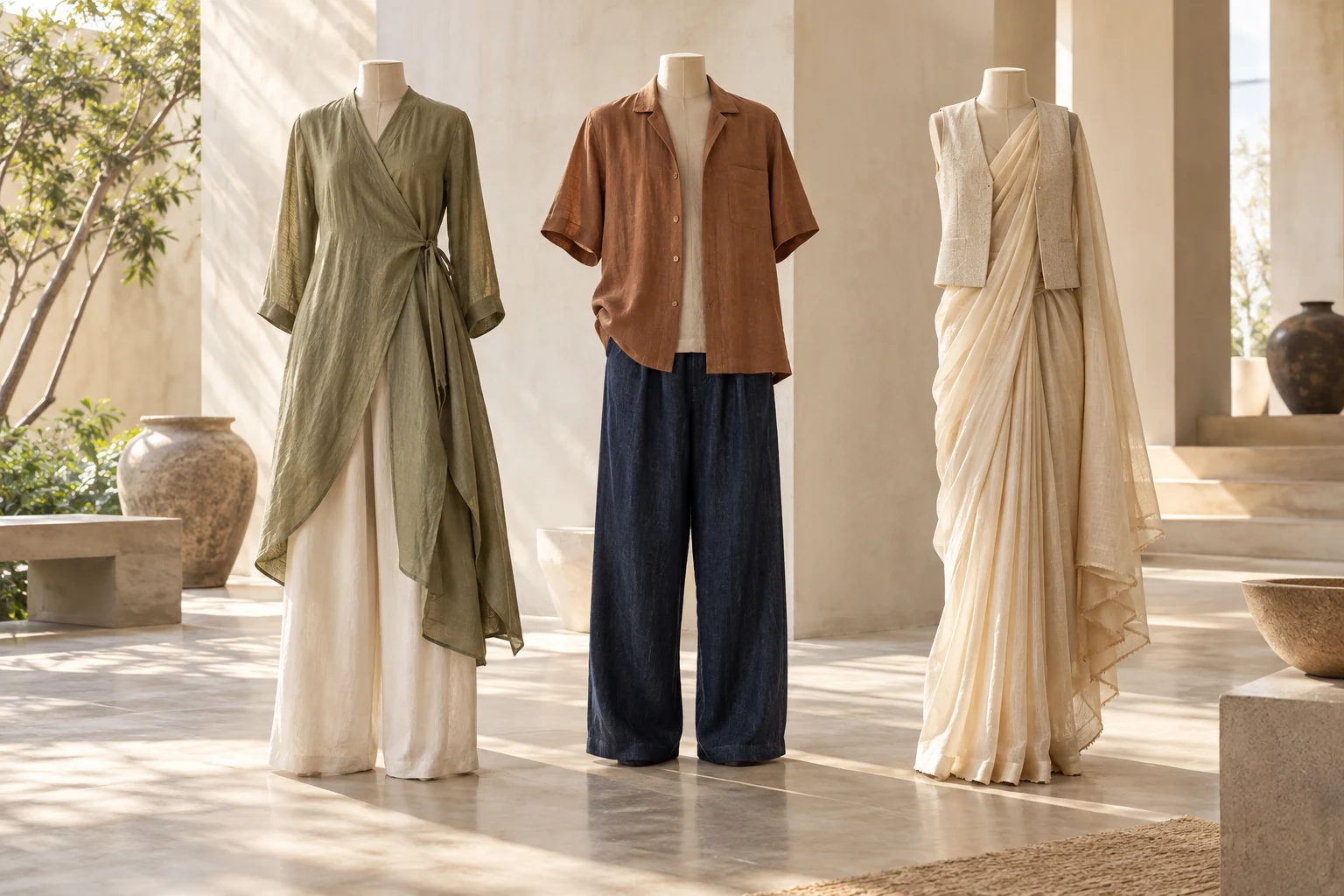
Explore fewer, more useful pieces: breathable modular sets, repair-friendly construction and identifiable local craft. These are conditional development scenarios to revisit when 2027–28 signals arrive.
Research reviewed 15 October 2026 · Original Forecut analysis
Complete season report with images, all active details, palette, design guidance, calendar and sources.
Original AI-generated Forecut concept art. Not a documented runway image.
Direction 01
Adaptable summer sets
Scenario: versatility becomes a stronger reason to buy if shoppers want fewer occasion-specific pieces. Airy and adjustable 2027 runway ideas are an early design input only.
Public trade coverage supports light natural blends, fluid shirting, textured weaves and sheer layers. Supplier availability must be verified.
Direction 02
Repair is part of the product
Scenario: dependable aftercare helps distinguish premium craft. It depends on service economics and customer adoption, neither of which is established for 2028.
Build the range
Replaceable buttons and ties; spare trim kits; accessible seams; detachable occasion panels.
Development notes
Document repair steps and stock compatible components. Test that removable trims still survive normal wear.
Commercial action
Cost the service separately before promising it. Measure repair use, lead time and margin impact in a pilot.
Materials benchmarking highlights the need to distinguish sourcing commitments from actual scale. Circular-material claims require traceable supplier evidence.
Direction 03
Craft with a clear origin
Scenario: customers reward specific provenance over broad craft language. Local making is an identity cue, not automatic proof of lower impact.
Materials benchmarking highlights the need to distinguish sourcing commitments from actual scale. Circular-material claims require traceable supplier evidence.
Direction 04
Soft structure for daily dressing
Scenario: summer tailoring stays relaxed while becoming more purposeful. Build recognisable shapes with better finishing instead of adding novelty to every style.
Designer interview: functional linings, wearable drapes and tonal craft in menswear. An occasionwear input, not measured retail demand.
Original working palette
Summer 28 colour direction
Use for sampling and range coordination. Validate physical lab dips under your selling light; these digital colours are not textile standards.
Loom neutral#EAE0CC
Dry sage#8C9F82
Clay earth#AA5C3E
Deep indigo#344A73
Muted shell#D8B6AA
Category opportunities
Womenswear
Scenario focus: flexible kurta sets, light everyday sarees and detachable occasion layers. Confirm appetite through 2027 customer tests.
Menswear
Scenario focus: unstructured layers and purposeful adjustment; keep dependable straight silhouettes as the comparison group.
Fusion & western
Scenario focus: wardrobe-compatible sets with a small craft signature, rather than speculative microtrends.
Footwear
Explore repairable components and comfortable lasts only with supplier trials; no 2028 sneaker adoption claim is made.
Textiles & trims
Trial traceable blends, repair components and lighter constructions. Availability, certifications and wash performance must precede volume booking.
Development calendar
April–September 2027Recheck SS28 trade and runway inputs as they become available; revise or reject these scenarios.
October–December 2027Run customer pilots, aftercare costing and fit trials; lock only validated materials and silhouettes.
January–February 2028Approve production against verified quality, demand and festival calendar.
March–July 2028Track sales and returns against the pilot baseline; update scenarios with measured evidence.
What would change this forecast?
A scenario advances only after repeated brand signals and customer testing.
If modular details raise defects or returns, simplify the construction.
Review SS28 collections when published; this report does not describe shows that have not happened.
Research sources & methodology · 7 sources
Forecut editorial forecasts synthesise public Indian designer interviews, international SS27 show notes, textile-trade coverage and brand collections. Runway presence is not sell-through. Lifecycle labels are qualitative development priorities, not measured market shares. 2028 entries are conditional scenarios; no 2028 runway or sales evidence is claimed. Palettes are original Forecut working colours, not an official colour authority forecast. Festival groupings are merchandising windows, not verified religious dates; Eid timing requires a separate calendar check.
Materials benchmarking highlights the need to distinguish sourcing commitments from actual scale. Circular-material claims require traceable supplier evidence.
Designer interview: functional linings, wearable drapes and tonal craft in menswear. An occasionwear input, not measured retail demand.
Forecut India · Festive 28
Celebration, built to keep
Long-range scenario · low confidence; review before any commercial commitment
Explore occasionwear whose value comes from reconfiguration, provenance and aftercare. This is an original Forecut planning scenario, not a claim about confirmed 2028 consumer preferences or designer collections.
Research reviewed 15 October 2026 · Original Forecut analysis
Complete season report with images, all active details, palette, design guidance, calendar and sources.
Original AI-generated Forecut concept art. Not a documented runway image.
Direction 01
The occasion wardrobe, recomposed
Scenario: an existing saree, skirt or kurta gains new life through a fresh layer. Current modular and lighter-occasion inputs support prototyping, not a prediction of guaranteed uptake.
Designer interview: functional linings, wearable drapes and tonal craft in menswear. An occasionwear input, not measured retail demand.
Direction 02
Heirloom surfaces, modern placement
Scenario: restrained craft placement makes premium pieces easier to wear again. Heritage should be credited rather than reduced to a generic luxury claim.
Build the range
Narrow woven borders; tonal Bandhani; placed Kantha-inspired handwork through the appropriate maker partnership.
Development notes
Approve stitch density and motif placement on actual size sets. Build traceability and artisan payment into sourcing briefs.
Commercial action
Test one craft family across a limited range. Validate lead times and gross margin after handwork and finishing costs.
Public textile-fair overview puts material development at the centre. Used as a long-lead input, not as a reproduced proprietary forecast.
Direction 03
Repairable occasion shine
Scenario: aftercare becomes part of the premium proposition. Reflective couture offers a visual reference but creates particular durability and storage challenges.
Materials benchmarking highlights the need to distinguish sourcing commitments from actual scale. Circular-material claims require traceable supplier evidence.
Direction 04
Local making, contemporary shape
Scenario: recognisable local techniques pair with contemporary separates. The opportunity depends on supply reliability and demonstrated customer interest.
Materials benchmarking highlights the need to distinguish sourcing commitments from actual scale. Circular-material claims require traceable supplier evidence.
Original working palette
Festive 28 colour direction
Use for sampling and range coordination. Validate physical lab dips under your selling light; these digital colours are not textile standards.
Aubergine wine#683047
Forest shade#204C40
Aged gold#BAA375
Parchment#E8DDCA
Smoky blue#53627B
Category opportunities
Womenswear
Explore reconfigurable saree and skirt outfits and placed craft. Avoid extending today’s trend curve automatically into 2028.
Menswear
Explore contemporary jackets, draped accessories and comfortable occasion trousers; test regional temperature needs.
Fusion & western
Explore component-led occasion capsules that work with existing wardrobe basics. Validate mix-and-match fit and styling clarity.
Footwear
Explore repair-friendly occasion flats and removable decorative elements where safe; wear and snag testing come first.
Textiles & trims
Prioritise verifiable origin and repeatable quality. Keep novel material development conditional on testing and commercial supply.
Development calendar
July–December 2027Check Indian couture, festive retail and trade-fair developments; replace unsupported scenarios.
April–July 2028Run wear, repair and quality tests; lock only proven options and verified festival delivery windows.
August–December 2028Monitor sell-through and returns by event and region; record which hypotheses actually performed.
What would change this forecast?
Do not use 2026 couture as proof of 2028 mass-market adoption.
Stop material experiments when safe care or repair cannot be offered.
Replace this scenario with direct 2028 evidence as it becomes available; next planned research checkpoint: July 2027.
Research sources & methodology · 7 sources
Forecut editorial forecasts synthesise public Indian designer interviews, international SS27 show notes, textile-trade coverage and brand collections. Runway presence is not sell-through. Lifecycle labels are qualitative development priorities, not measured market shares. 2028 entries are conditional scenarios; no 2028 runway or sales evidence is claimed. Palettes are original Forecut working colours, not an official colour authority forecast. Festival groupings are merchandising windows, not verified religious dates; Eid timing requires a separate calendar check.
Materials benchmarking highlights the need to distinguish sourcing commitments from actual scale. Circular-material claims require traceable supplier evidence.
Detail report
Every detail, by category
Open any detail to see it on a flat sketch, follow its lifecycle across seasons and download it as an image card.
Season
Long-range outlook: statuses are projected from today's signals. New emerging details are added each month as they appear.
Womenswear
Women's Ethnic
Sarees
SareesEmerging
Office-ready fluid sarees
Light printed sarees styled for work, as shown by Satya Paul.
View detail →
SareesEmerging
Foil-appliqué tulle sarees
Metallic foil or faux-leather pieces cut into shapes and stitched onto sheer tulle, as shown by Sameer Madan.
View detail →
SareesEmerging
Metallic grey pre-draped sarees
Silver-grey georgette pre-draped sarees with mirror and sequin work and a sleeveless sequinned blouse, as on Shilpa Shetty at Ramesh Taurani's Diwali party, Mumbai, 3 Nov 2026: a quieter alternative to gold.
View detail →
SareesRising
Pre-draped saree gowns
Ready-to-wear sarees with stitched pleats and a fixed pallu, worn in minutes.
View detail →
SareesRising
Tissue sarees in champagne gold
Metallic tissue as the base colour, not just the border.
View detail →
SareesRising
Pastel handloom sarees
Dusty rose, powder blue and lavender on handloom bases.
View detail →
SareesRising
Sarees with belts and jackets
Waist belts and cropped jackets over sarees for a modern drape.
View detail →
SareesRising
Ombré silk sarees with contrast blouses
Silk sarees shading from pastel pink to deep red with gold zari florals, worn with a contrast emerald silk blouse, as on Shilpa Shetty at the Kapoors' Karwa Chauth gathering, Mumbai, 29 Oct 2026.
View detail →
SareesRising
Mirror-bordered tissue sarees
Beige-gold tissue silk sarees edged with mirror-work borders and a matching high-neck blouse, as on Mira Rajput in Mumbai, 29 Oct 2026; a lighter way to wear mirror work for evening functions.
View detail →
SareesRising
Halter-neck saree blouses
Halter-neck blouses replacing the classic choli under metallic and sequinned sarees, as on Kareena Kapoor Khan (champagne-gold sequin saree) at Manish Malhotra's Diwali party and Bhumi Pednekar (halter cross-neck blouse) at Ramesh Taurani's, Mumbai, Nov 2026.
View detail →
SareesRising
Black velvet sarees
Black velvet sarees with embellished borders for winter evening functions, as on Kajol at Manish Malhotra's Diwali party, Mumbai, Nov 2026; velvet suits the cooler North Indian wedding months.
View detail →
SareesPeaking
Organza sarees with scalloped borders
Sheer, structured organza that photographs well.
View detail →
Lehengas
LehengasEmerging
Fish-cut lehenga skirts
Fitted through the hip, flaring at the knee for a longer line.
View detail →
LehengasEmerging
Tiger-stripe fishtail lehengas
Black-and-gold stripe-patterned lehengas cut close through the hip and flared at the hem, worn with a sheer dupatta, as on Janhvi Kapoor at Manish Malhotra's Diwali party, Mumbai, Nov 2026.
View detail →
LehengasRising
Cape lehengas
Lehengas with a cape-style dupatta or overlay.
View detail →
LehengasRising
Ombré and dual-tone lehengas
Skirts shading from a deep base into a lighter hem.
View detail →
LehengasRising
Light organza lehengas
Airy organza lehengas for sangeet and day functions.
View detail →
LehengasRising
Black mirror-work lehengas
Black lehengas worked in mirrors, hand embroidery and metallic accents, with a bralette blouse and sheer sequinned dupatta, as worn by Kriti Sanon closing Abhinav Mishra's Into the Wild 2026, New Delhi, 24 Oct 2026.
View detail →
LehengasPeaking
Crop-top lehenga sets
Shorter blouses with high-waisted skirts.
View detail →
LehengasNot tracked in this season
Pocketed light occasion skirts
A lighter wedding-guest skirt with supported pockets and an independently wearable top. Check pocket distortion.
View detail →
Suits & kurtas
Suits & kurtasEmerging
Angrakha wrap kurtas
Overlapping wrap fronts tied at the side.
View detail →
Suits & kurtasEmerging
Sheer organza jackets over anarkalis
A sheer, gold-trimmed organza jacket worn open over a crushed-texture anarkali, as on Sonam Kapoor (crimson anarkali, rust-orange organza jacket) in Mumbai, 29 Oct 2026. An easy add-on that refreshes an existing anarkali.
View detail →
Suits & kurtasRising
Embroidered kurta co-ord sets
Matching kurta and trousers with coordinated embroidery.
View detail →
Suits & kurtasRising
Festive kaftan kurtas
Kaftans with Indian prints and embroidery, worn to festive events.
View detail →
Suits & kurtasRising
Kalidar-cut kurtas
Kurtas built from many flared panels (kalis) for swing without heavy gathers; seen in Max Fashion Festive 2026.
View detail →
Suits & kurtasPeaking
Fit-and-flare Anarkalis
Flattering, comfortable Anarkalis that suit most occasions.
View detail →
Suits & kurtasPeaking
Straight kurtas with palazzos
Straight-cut suits with wide palazzos for comfort.
View detail →
Suits & kurtasNot tracked in this season
Airy kurta separates with opacity-tested inners
Separate inner and loose outer layers for coverage with less bulk. Test opacity, shrinkage and seam stability.
View detail →
Blouses & dupattas
Blouses & dupattasEmerging
Collared shirt blouses
Crisp collared blouses for a tailored saree look.
View detail →
Blouses & dupattasRising
Corset saree blouses
Structured corset blouses as a modern alternative.
View detail →
Blouses & dupattasRising
Off-shoulder blouses
Off-shoulder blouses for sarees and lehengas.
View detail →
Blouses & dupattasPeaking
Organza dupattas with embroidered borders
Sheer dupattas framed with an embroidered edge.
View detail →
Rewear systems
Rewear systemsNot tracked in this season
Reconfigurable saree occasion layers
Festive 28 hypothesis: refresh an existing saree with an independent layer. Validate attachment security and fit.
View detail →
Menswear
Men's Ethnic
Kurtas & sets
Kurtas & setsEmerging
Floral kurtas with harem trousers
Deep-toned floral-print kurtas paired with relaxed harem trousers instead of churidars, as worn by Aamir Khan in Mumbai, 29 Oct 2026; a softer, comfortable festive set for men.
View detail →
Kurtas & setsRising
Linen kurta sets
Breathable linen and cotton-silk for relaxed celebrations.
View detail →
Kurtas & setsRising
Short kurtas with jeans
Hip-length kurtas worn with denim for everyday wear.
View detail →
Kurtas & setsRising
Asymmetric-hem kurtas
Angled or layered hems for a modern kurta.
View detail →
Kurtas & setsRising
Pathani suits
Collared Pathani kurtas with salwar, in solid tones.
View detail →
Kurtas & setsRising
Neckline and cuff embroidery
Subtle embroidery placed only at the neckline and cuffs.
View detail →
Kurtas & setsRising
Burgundy velvet kurtas
Dark burgundy velvet kurtas worn with black trousers, as on Vicky Kaushal at Manish Malhotra's Diwali party, Mumbai, Nov 2026, with burgundy velvet co-ords on women the same night.
View detail →
Kurtas & setsPeaking
Straight kurta with band collar
Straight kurtas with a Nehru (band) collar and churidar or straight trousers.
View detail →
Jackets & bandhgalas
Jackets & bandhgalasEmerging
Contrast-piped Nehru jackets
Contrast piping on the collar and edges.
View detail →
Jackets & bandhgalasRising
Tone-on-tone bandhgalas
Bandhgala (Jodhpuri) suits with tonal embroidery instead of heavy work.
View detail →
Jackets & bandhgalasRising
Velvet bandhgalas
Velvet bandhgalas in bottle green, navy and burgundy for winter weddings.
View detail →
Jackets & bandhgalasRising
Collar brooches on bandhgalas
A brooch or decorative button at the bandhgala collar.
View detail →
Jackets & bandhgalasPeaking
Brocade and Chanderi Nehru jackets
Nehru jackets over kurtas or shirts, in brocade, Chanderi or jacquard.
View detail →
Occasion & wedding
Occasion & weddingEmerging
Fluid draped menswear
Relaxed drapes and soft tailoring, as shown by AK|OK.
View detail →
Occasion & weddingEmerging
Tussar and Kanjeevaram menswear
Silks usually reserved for women, cut for men by Vivek Karunakaran.
View detail →
Occasion & weddingEmerging
Pre-draped doshalas
Ready-draped shawls (doshalas) fixed over the shoulder of a bandhgala and angrakha-style tunic, as in Tasva by Tarun Tahiliani at Lakmē x FDCI, Oct 2026. Easier for grooms and guests than a loose shawl.
View detail →
Occasion & weddingPeaking
Ivory and pastel sherwanis
Ivory, mint and powder shades for day weddings.
View detail →
Bottoms
BottomsRising
Straight trousers over churidars
Straight trousers replacing fitted churidars under kurtas.
View detail →
BottomsRising
Dhoti pants and cowl trousers
Draped dhoti pants for sangeet and mehendi.
View detail →
Summer tailoring
Summer tailoringNot tracked in this season
Half-lined textured Nehru layers
Light textured cloth with reduced lining bulk; check collar recovery and perspiration marks.
View detail →
Occasion construction
Occasion constructionNot tracked in this season
Secure draped occasion stoles
Develop unobtrusive original fastening solutions for free movement; stress-test closures and skin contact.
View detail →
Rewear systems
Rewear systemsNot tracked in this season
Reversible light occasion waistcoats
Festive 28 hypothesis: two useful faces with stable seams and unobtrusive labels. Validate demand before booking cloth.
View detail →
Fusion
Indo-Western
Women
WomenEmerging
Draped dhoti skirts
Dhoti-inspired draped skirts with crop tops or shirts.
View detail →
WomenRising
Sarees with sneakers
Sarees worn with clean sneakers for day events.
View detail →
WomenRising
Jackets over lehengas
Cropped or denim jackets layered over lehengas.
View detail →
WomenRising
Printed fusion kaftans
Kaftans with Indian print and embroidery for festive brunches.
View detail →
Men
MenEmerging
Indo-western blazer sets
Bandhgala-collar blazers with matching trousers.
View detail →
MenEmerging
Kurta-shirt hybrids
Gender-fluid shirts with kurta length and band collars.
View detail →
Everyday
EverydayEmerging
Chanderi with denim
Silk Chanderi paired with denim, as shown by Saim.
View detail →
EverydayEmerging
Embroidered denim jackets
Denim jackets with Indian embroidery.
View detail →
EverydayRising
Indigo denim with handloom
Indigo denim teamed with handloom pieces.
View detail →
EverydayPeaking
Kurtas with jeans and sneakers
The everyday Gen Z mix of kurta, denim and sneakers.
View detail →
Evening fusion
Evening fusionEmerging
Zari-embroidered denim eveningwear
Denim and Tencel lifted to evening with zari embroidery, as shown by Spacelines.
View detail →
Evening fusionEmerging
Black-and-gold evening gowns
Black eveningwear lifted with gold embroidery and metallic finishes: Namrata Joshipura OBSIDIAN and Samant Chauhan's halter gown with gold florals and 3D ruffles at Lakmē x FDCI, Oct 2026.
View detail →
Wardrobe systems
Wardrobe systemsEmerging
Modular organza occasion separates
Occasion pieces in organza, silk and washed denim that mix and re-pair across events, as shown by Nachiket Barve.
View detail →
Wardrobe systemsNot tracked in this season
Modular travel kurta sets
Summer 28 hypothesis: compatible separates with useful adjustment. Validate through paid customer pilots in 2027.
View detail →
Summer layers
Summer layersNot tracked in this season
Adjustable light draped separates
Trial secure ties and adjustable drape for seated and walking comfort. Keep styling instructions clear.
View detail →
Western
Western Wear (India)
Women
WomenEmerging
Baby tees and low-rise denim
Soft Y2K: baby tees with low or mid-rise jeans.
View detail →
WomenEmerging
Breezy resort dresses
Easy, resort-style dresses for city daytime, as shown by Verandah.
View detail →
WomenRising
Monochrome co-ords
Matching tops and trousers in one colour.
View detail →
Men
MenRising
Boxy blazers and straight trousers
Relaxed, gender-fluid tailoring for internships and work.
View detail →
MenRising
Varsity jackets
Retro varsity jackets for campus wear.
View detail →
MenPeaking
Cargo and utility pants
Cargo pants and workwear jackets with street details.
View detail →
Unisex
UnisexRising
Athleisure co-ord sets
Matching jogger and sweat sets for hybrid campus days.
View detail →
UnisexRising
Quiet-luxury basics
Crisp shirts, neutral trousers and clean sneakers.
View detail →
UnisexPeaking
Baggy and wide-leg jeans
Relaxed, wide denim for comfort.
View detail →
UnisexPeaking
Oversized tees and shirts
Roomy tees and boyfriend shirts.
View detail →
Footwear
Indian Footwear
Ethnic
EthnicRising
Kolhapuri chappals
GI-tagged Kolhapuris, back in focus after Prada's Spring/Summer 2026 show.
View detail →
EthnicRising
Block-heel juttis
Juttis on a low block heel for comfort at long events.
View detail →
EthnicRising
Mirror-work flats
Mirror embellishment moving onto shoes.
View detail →
EthnicPeaking
Embellished wedding juttis
Juttis with zari, beads and mirror work for weddings.
View detail →
EthnicPeaking
Pointed juttis with bandhgalas
Pointed juttis as the correct shoe for bandhgalas.
View detail →
EthnicPeaking
Mojaris with kurta sets
Classic mojaris for festive kurta looks.
View detail →
Sneakers
SneakersEmerging
Handcrafted leather sneakers
Full-grain leather sneakers made in India.
View detail →
SneakersEmerging
Kantha-embroidered sneakers
Suede sneakers with kantha embroidery.
View detail →
SneakersEmerging
Wide lasts for Indian feet
Broader lasts shaped for Indian foot widths.
View detail →
SneakersRising
Retro gum-sole sneakers
Vintage trainers with suede overlays and gum soles.
View detail →
SneakersRising
Sneakers for the groom
Embellished or clean sneakers for sangeet and mehendi.
View detail →
Comfort development
Comfort developmentNot tracked in this season
Serviceable occasion-flat components
Summer 28 hypothesis: explore replaceable parts with footwear suppliers; safety, adhesion and flex tests come before scale.
View detail →
Fabrics, craft & trims
Fabrics & Weaves
Handloom
HandloomEmerging
Handspun khadi
Khadi in silk, wool, linen and cotton, shown at the Navdhara Khadi showcase.
View detail →
HandloomRising
Maheshwari
Fine cotton-silk handloom with reversible borders.
View detail →
HandloomRising
Jamdani
Hand-woven motifs on fine cotton.
View detail →
HandloomPeaking
Chanderi
Light, sheer Madhya Pradesh weave for kurtas, sarees and jackets.
View detail →
Silks
SilksEmerging
Reworked vintage Banarasi
Vintage Banarasi cut into structured eveningwear, as by Amit Aggarwal.
View detail →
SilksEmerging
Bhagalpur silk
Bihar silk used for structured gowns.
View detail →
SilksRising
Tussar silk
Textured, natural-gold wild silk.
View detail →
SilksPeaking
Banarasi brocade
Rich woven brocade for weddings and Nehru jackets.
View detail →
SilksPeaking
Kanjeevaram silk
Heavy South Indian silk for weddings, now also in menswear.
View detail →
SilksPeaking
Raw silk
Textured, earthy silk for bandhgalas and lehengas.
View detail →
Sheers & metallics
Sheers & metallicsRising
Tissue
Metallic sheen for evening functions.
View detail →
Sheers & metallicsPeaking
Organza
Sheer, structured and photogenic.
View detail →
Everyday
EverydayEmerging
Natural-dyed fabrics
Plant dyes and slow processes.
View detail →
EverydayEmerging
Tencel and bamboo blend suiting
Separates and menswear cut from cotton, wool, linen, Tencel and bamboo blends, as in Ashish N Soni with Arvind at Lakmē x FDCI, Oct 2026, with select looks sold at The Arvind Stores.
View detail →
EverydayRising
Linen
Breathable linen for summer kurtas and co-ords.
View detail →
EverydayPeaking
Cotton silk
Comfortable, breathable everyday ethnic fabric.
View detail →
Silks & metallics
Silks & metallicsRising
Crushed tissue
Crinkled metallic tissue with a soft, broken shine, used for festive suits and sarees, as shown in Soch Festive 2026.
View detail →
Sourcing trials
Sourcing trialsNot tracked in this season
Traceable lightweight blend trials
Summer 28 hypothesis: test light blends with supplier composition and origin records. Certification does not replace performance testing.
View detail →
Embroidery & Surface
Hand embroidery
Hand embroideryEmerging
Rabari embroidery
Kutch Rabari embroidery, shown by Kartik Research.
View detail →
Hand embroideryEmerging
Kantha
Running-stitch embroidery from Bengal.
View detail →
Hand embroideryRising
Mirror work
Mirror work on garments, dupattas, bags and shoes.
View detail →
Hand embroideryRising
Tone-on-tone embroidery
Embroidery in the fabric colour for quiet luxury.
View detail →
Hand embroideryPeaking
Chikankari
Lucknow white-on-white embroidery for summer and festive.
View detail →
Hand embroideryPeaking
Zardozi
Metal-thread embroidery for weddings.
View detail →
Hand embroideryPeaking
Gota patti
Rajasthani ribbon appliqué in gold and silver.
View detail →
Prints & dyes
Prints & dyesEmerging
Patchwork and layered textures
Patchwork and layered textures, as shown by Kartik Research.
View detail →
Prints & dyesEmerging
Tile-inspired layered prints
Repeating tile and jaali motifs printed in overlapping layers on kurtas and sets, as shown in Soch Festive 2026.
View detail →
Prints & dyesRising
Bandhani
Tie-dye dots from Gujarat and Rajasthan.
View detail →
Prints & dyesRising
Ikat
Resist-dyed yarns woven into blurred patterns.
View detail →
Prints & dyesPeaking
Block print
Hand block prints from Bagru and Sanganer.
View detail →
Embellishment
EmbellishmentEmerging
Glass-bead and zardozi layering
Zardozi, threadwork, sequins and glass beads layered into dimensional, colourful bridal surfaces, as in Anushree Reddy MAYA at Lakmē x FDCI, Oct 2026.
View detail →
EmbellishmentFading
All-over heavy sequins
Head-to-toe sequins giving way to placement work.
View detail →
Craft accents
Craft accentsNot tracked in this season
Crochet-edged summer shirts
Small crochet accents on breathable shirts; approve repeatability and wash recovery before scaling.
View detail →
Placed ornament
Placed ornamentNot tracked in this season
Controlled metallic-cord accents
Small placed reflective details, limited to premium trials. Check weight, abrasion, repair and humidity exposure.
View detail →
Craft development
Craft developmentNot tracked in this season
Maker-attributed placed craft capsules
Festive 28 hypothesis: a limited range built with a named craft partner. Confirm origin, labour cost and capacity before claims.
View detail →
Trims & Accessories
Trims
TrimsEmerging
Raw, unfinished edges
Deliberately unfinished edges, as shown by AK|OK.
View detail →
TrimsEmerging
Enamel clasps and closures
Small enamelled clasps used as a crafted closure on kurtas and accessories, as shown by AMPM.
View detail →
TrimsRising
Contrast piping
Piping on collars, cuffs and edges of kurtas and jackets.
View detail →
TrimsRising
Potli and fabric-covered buttons
Small round buttons as a crafted finish.
View detail →
TrimsPeaking
Latkans and tassels
Decorative tassels on blouses, dupattas and drawstrings.
View detail →
TrimsPeaking
Scalloped and cutwork borders
Scalloped edges on sarees, dupattas and sleeves.
View detail →
Accessories
AccessoriesRising
Belts over sarees and kurtas
Embellished or leather belts to define the waist.
View detail →
AccessoriesRising
Mirror-work bags
Bags with mirror embellishment.
View detail →
AccessoriesRising
Statement brooches
Brooches on bandhgalas, kurtas and saree pallus.
View detail →
AccessoriesPeaking
Potli bags
Drawstring pouch bags for festive looks.
View detail →
Occasion layers
Occasion layersNot tracked in this season
Detachable festive cape panels
Trial a removable occasion layer with discreet, durable attachment points and clear care instructions.
View detail →
Aftercare
AftercareNot tracked in this season
Replaceable ties and spare trim kits
Summer 28 hypothesis: documented repair components supplied with selected products. Cost the service before promising it.
View detail →
Repairable ornament
Repairable ornamentNot tracked in this season
Removable occasion embellishment panels
Festive 28 hypothesis: separate fragile ornament for storage and servicing. Test snagging and care economics.
View detail →
No details match these filters. Clear a status filter or try another search word.
Why now
Who's showing it
Category focus
Share of this season's related details by garment category.
Price guide
Key garment
Value
Mid
Premium
Indicative retail ranges in ₹ for the India market (value: high street and D2C; mid: contemporary brands; premium: designer). Forecut planning estimates, not live market data. Check against your own range and costings.
India trends summarise public coverage of Lakmé Fashion Week x FDCI 2026 (Harper's Bazaar India, Free Press Journal), Aza Fashions festive and ethnic trend guides, Lashkaraa colour and silhouette trends 2026, Pearl Academy Gen Z trend reports, Gully Labs, Global Indian (Prada SS26 Kolhapuri-inspired sandals) and Outlook Business (Gen Z and e-retail). Individual details and their statuses are Forecut's curated assessment, written in our own words. Colour swatches are screen approximations, not official colour standards. Questions or feedback: hello@forecut.in. Forecut is free while in testing.
Status key: Emerging early signals · Rising gaining fast, add now · Peaking at full adoption, use in core styles · Fading phase out in new development.